
Most scrap dealers do not struggle because there is too little scrap around them. They struggle because pickup requests arrive unevenly, vehicles run half-empty on long routes, crews wait for instructions, and good customers quietly move to the next kabadiwala who answers the phone first.
If you want to know how to grow scrap business income without simply working longer hours, the answer usually lies in three areas:
- More pickups: reaching more households, shops and offices
- More repeat customers: making sure each new seller keeps calling back
- Better operations: running crews and vehicles with a clear daily plan
The 10 steps below cover all three. They are written for small and medium scrap dealers in India, whether you run a single three-wheeler or a godown with several vehicles.
1. Find What Is Really Holding Your Business Back
Before you add customers or vehicles, spend a week or two noting where your time and money actually go. Growth built on a leaking operation only makes the leak bigger.
Keep a simple daily log with these columns: pickups booked, pickups completed, kilometres driven, fuel spent, weight collected by material, and hours each crew was busy. After a fortnight, look for these patterns:
| What you see | What it usually means |
|---|---|
| Missed or delayed pickups | Poor scheduling, or too few crew members at peak times |
| High fuel cost, low weight collected | Scattered routes, or vehicles going out for single small jobs |
| Idle crews in the afternoon | Spare capacity, but not enough bookings |
| Low margin despite good volume | Mixed, unsorted material being sold at a lower rate |
Fix the biggest leak first. Once it is under control, move to the next one.
2. Widen Your Customer Network to Get More Pickups
Households give a steady flow of newspaper, cartons, plastic and small metal items. Shops, offices and workshops produce larger lots, often on a regular cycle. A healthy kabadi business serves both.
- Residential societies and colonies: Meet the society secretary or security supervisor and offer a fixed collection day for the whole building. A single visit can fill an entire route.
- Shops and small businesses: Kirana stores, electronics repair shops, printing presses, garages and tailoring units generate scrap every week. Visit in person and leave a card with your WhatsApp number.
- Offices and schools: Old files, furniture and electricals pile up in storerooms. Facility managers value punctual dealers who give clear weight slips.
- Referrals: Ask satisfied customers to recommend you to neighbours, relatives and the shops they use.
- Online visibility: Keep your Google Business Profile updated with correct timings, phone number, photos and the materials you buy.
Above all, be honest about what you buy and how you weigh. Sellers often stay for years with a scrap dealer they trust.
3. Turn One-Time Sellers into Repeat Customers
A customer who calls you every month is worth far more than a one-time seller, and keeping them costs far less than finding someone new.
- Keep a customer register. Note each customer’s name, area, phone number, usual materials and date of last pickup. A notebook works, but a spreadsheet or app is easier to search.
- Set collection cycles. Shops may need weekly visits, offices monthly, and households every one or two months.
- Send reminders. A short WhatsApp message the day before (“Namaste, our team will be in your area tomorrow morning. Do you have scrap ready?”) recovers pickups that would otherwise be forgotten.
- Arrive in the promised slot. If a crew is running late, call the customer before they call you.
4. Plan Tomorrow’s Pickups the Evening Before
Good scrap business management starts the evening before. Planning the next day’s work in one sitting is often the cheapest way to handle more pickups without buying another vehicle.
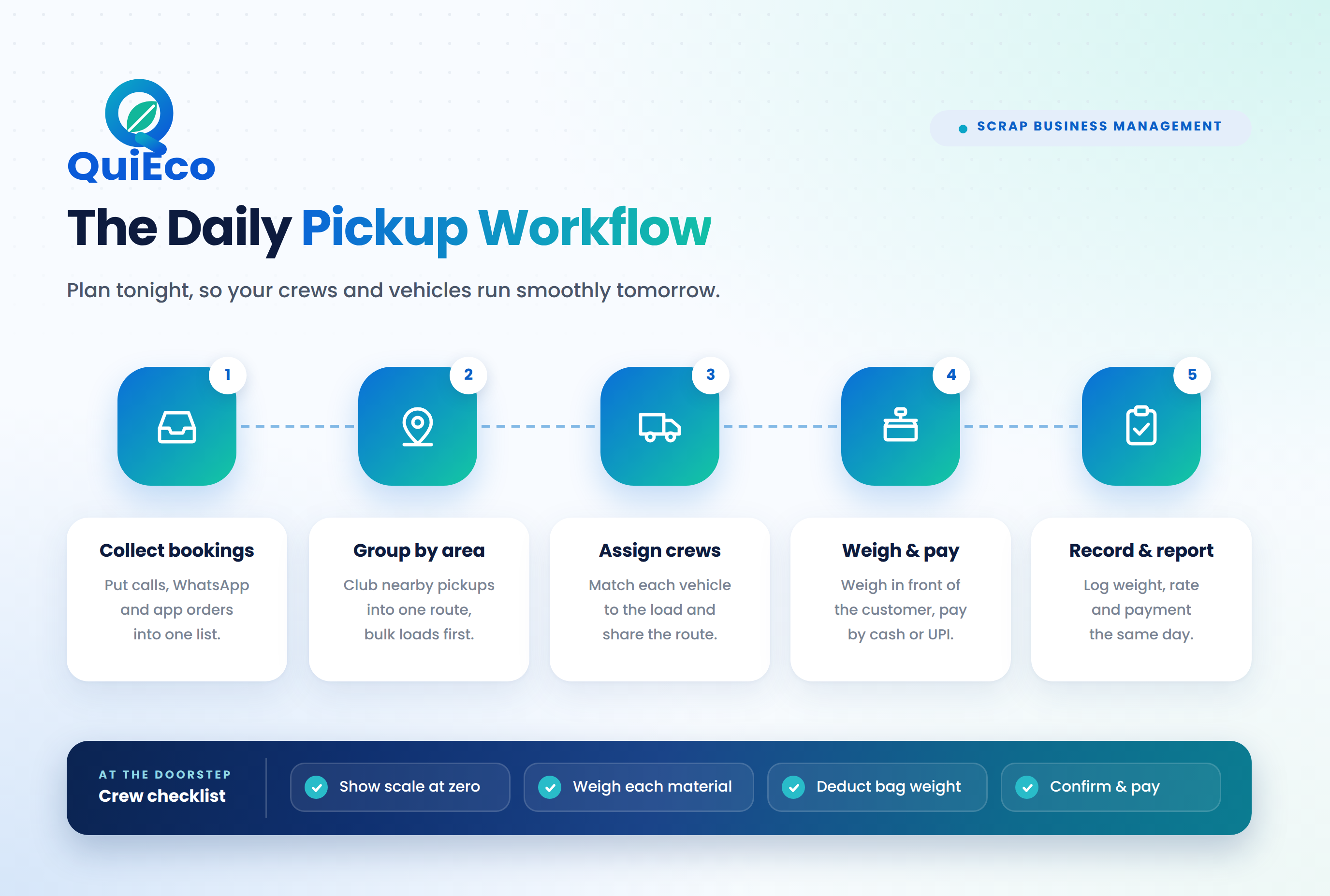
- Collect all bookings from calls, WhatsApp and any platforms you use into one list.
- Mark the size of each job: small household lot, medium shop lot or bulk commercial load.
- Group bookings by area, so pickups in neighbouring lanes go on the same route.
- Put time-bound jobs, bulk loads and regular customers first.
- Keep one or two slots free for urgent same-day requests.
When a new request comes in during the day, check whether a crew is already nearby before you commit to a time.
5. Run Your Crews and Vehicles Efficiently
Crews and vehicles are usually among your largest daily costs, so using them well matters as much as finding customers. Here, a crew means the team that visits homes and shops to weigh the scrap and pay the customer.
Match the vehicle to the job. Do not send a mini truck for a few kilos of newspaper, or a three-wheeler for an office clearance. Combine small household pickups into one loop and give bulk commercial loads their own trip.
Give each crew a clear route. Every crew should start the day knowing its addresses, the order of visits, customer phone numbers and the expected materials. Share the list on WhatsApp or through whatever tool you use, and ask crews to report after each stop so you know who is free for an extra job.
Prepare crews for the doorstep visit. At the customer’s door, your crew is your business. Give each crew a calibrated digital scale, enough cash and a UPI QR code, and train them to:
- Introduce your business by name and confirm the booking details
- Show the scale at zero, then weigh each material separately in front of the customer
- Deduct the weight of empty bags or sacks
- Confirm the weight and amount, pay by cash or UPI, and report the transaction the same day
Maintain vehicles on a schedule. Check tyres, brakes, oil and lights on a fixed day each week, and note the fuel filled and kilometres driven for each vehicle. If one vehicle’s fuel use suddenly rises, get it checked before it breaks down mid-route.
Plan for disruptions. Keep a backup driver, a spare vehicle arrangement and a ready message for rescheduled pickups. Software can help you assign jobs, but route planning and vehicle checks still depend on your daily routine.
6. Sort, Weigh and Record Everything Carefully
Sorting is where scrap turns into margin. Clean, separated material usually fetches a better rate than mixed lots, and accurate records show you exactly where your money is made.
- Segregate at the godown: Keep separate bays or bags for paper, cardboard, each plastic type, iron, aluminium, copper, brass and e-waste.
- Weigh accurately: Use a calibrated scale and get it verified and stamped by the Legal Metrology department on time. A stamped scale protects you in any dispute and builds customer trust.
- Record every purchase and sale: Note the date, customer, material, weight, rate and amount paid.
- Track stock levels: Knowing how much of each material you hold helps you decide when to sell.
- Keep payment proof: UPI records and receipts make accounts, and any future loan application, much easier.
7. Build Strong Relationships with Reliable Scrap Buyers
Steady selling matters as much as steady buying. Depending on a single wholesaler leaves you exposed if their rate drops or their payments get delayed.
- Spread your sales: Work with more than one buyer for each major material, such as a paper mill agent, a metal recycler and a plastic processor.
- Compare, but stay loyal where it counts: Check offers regularly, but do not chase every small rate difference at the cost of a dependable relationship.
- Supply consistent quality: Scrap buyers return to dealers whose material is clean, correctly graded and delivered on time.
- Put terms in writing: Record payment terms for every sale and follow up on dues in writing.
- Check compliance: Sell e-waste and hazardous material only to properly registered recyclers. Rules vary by state, so confirm what applies in yours.
8. Use Digital Tools to Run Your Kabadi Business
Running a business from memory and a diary works with ten customers, not with a hundred. As demand grows, so do the calls, records and payments you need to track.
Digital tools can help you:
- Keep customer details and pickup history in one place
- Receive and organise pickup requests without missing calls
- Share daily job lists with crews
- Record purchases, sales and payments
Start simple. A shared spreadsheet and a WhatsApp Business account already solve many problems. As your volume grows, a dedicated scrap dealer app or online panel can bring pickup requests, rates, crew assignments and earnings records together, which cuts down manual follow-up.
9. Track the Numbers That Drive Growth
Numbers are far more reliable than guesswork when you decide where to put your time and money. Track these every week:
| Metric | What it tells you |
|---|---|
| Pickups completed vs booked | How reliable your service is |
| Repeat customer rate | The share of pickups coming from returning customers |
| Missed or rescheduled pickups | Where your planning has gaps |
| Average weight per pickup | Which areas are worth regular visits |
| Fuel cost per pickup or route | Whether your routing is improving |
| Profit per route and per material | Where your real earnings come from |
There is no universal benchmark. Record your current figures as a baseline, make one change at a time, and compare the next month's results.
10. Add a Scrap Pickup Platform as Another Order Channel
Even with strong local networks, most dealers have idle hours and empty capacity on some routes. A scrap pickup platform can fill those gaps with orders from customers you would not otherwise reach.
Selling scrap from home rather than buying it? You can sell scrap online through the QuiEco app. See how QuiEco works to compare verified dealers near you and book a doorstep pickup.
Final Thoughts on How to Grow Scrap Business
There is no single trick for how to grow scrap business results. Steady growth comes from a set of small, repeatable habits:
- Reaching more households, shops and offices
- Giving every customer a reason to call you again
- Planning routes the evening before and matching vehicles to jobs
- Sorting material carefully and selling to reliable buyers
- Tracking a few numbers every week
Pick the area costing you the most time or money this month, fix it, then move to the next. If you want another channel for pickup orders and one place to manage rates, crews and earnings, become a QuiEco Partner.